
Fields in Warren County Tax Records
A parcel result is more than a balance screen. In the public Auditor record, one parcel identity holds gross assessment, deductions, and taxable assessment. Tax rates, charges, payments, transfers, and notes sit alongside them. Each office plays its own part. The Treasurer collects the bill. The Assessor sets gross assessed value. The Auditor applies deductions and maintains transfer books. Keeping those duties straight keeps a payment line from being mistaken for a valuation decision.
| Tax record field | Meaning | Responsible source |
|---|---|---|
| Gross assessment | Land and improvement value before deductions | County Assessor |
| Deductions | Approved reductions used in the calculation | Auditor and Assessor |
| Taxable assessment | Value remaining after deductions | Auditor parcel record |
| Charges | Current bill, installments, and balance | Treasurer and Auditor |
| Taxing units | Government and service shares | Auditor tax detail |
| Payments | Receipt, date, type, amount, and amount due | Treasurer and Auditor |
Indiana assessments aim at market value-in-use, meaning value in the property's current use. The bill is still not a sale estimate. Deductions, credits, caps, local rates, and the payable-year cycle can all make similar assessments produce very different bills.
Search Warren County Property Tax Fields
The Warren County Auditor Tax List accepts several search keys. Its instructions say to use a property or parcel number when known. An owner name also works. So does a property address, and it may include the city. Start with less text, then add more. Too much detail can narrow the results too far. A recent split or combination can complicate things. A last-name search may be the only way to find every bill.
| Search control | Input | Local use |
|---|---|---|
| Dist# | Optional text | Narrows by tax district |
| Parcel # | Optional text | Uses the long parcel identifier |
| Name | Optional text | Last name is the broad fallback |
| Tax Year | Optional choice | Selects an available year |
| Property Address | Optional text | Accepts street and may include city |
| Maximum | Optional number | Controls returned rows |
The list labels itself "Not for Official Use" and displays a last-updated date. Save that date alongside the parcel number. A live result can change after a payment or a deduction decision. It can also change after a deed transfer or a parcel split.
Note: Warren County advises an owner-name search after a split in the last two years. It advises the same after a combination.
Trace a Warren County Tax Bill
A sound lookup follows the bill from a broad search to office confirmation. The parcel number is the best bridge. Street styles vary, after all. An owner's mailing address may also differ from the property's physical, or situs, address.
- Search the Auditor tax list with the street address. Reduce the entry to street number and name if the first query is too narrow.
- Open the matching row and compare situs, owner, parcel number, map number, legal description, and tax district.
- Read assessment year and payable year, then review gross assessment, deductions, taxable assessment, taxing units, charges, payments, and balance.
- Use the Warren County Treasurer for an official payoff, delinquency question, tax-sale status, or recent payment.
- Assessed value
- The tax value assigned under Indiana's market-value-in-use standard.
- Taxable assessment
- The assessment remaining after approved deductions.
- Levy or tax rate
- The rate applied through the parcel's taxing units.
- Homestead deduction
- Principal-residence relief; its presence does not prove current occupancy.
- Tax lien
- A claim tied to unpaid tax that needs current office confirmation.
West Lebanon Tax Units on One Parcel
A West Lebanon parcel card shows why local context matters. Its legal description reads PETRO ADD LOT 6. Its long parcel number ends in district 010. The page calls that district West Lebanon (Pike). The calculation includes Warren County, Pike Township, and West Lebanon Civil Town. The county school corporation, West Lebanon Public Library, and county solid waste also appear. Those lines name the public bodies sharing the calculation. They do not describe private title interests.
The same Warren County property tax record displays a 2025 Payable 2026 heading, gross assessment, homestead entries, taxable assessment, installment charges, historical rows, payments, and transfer notes. Owner history helps, but transfer rows leave instrument, book, and page fields blank. The deed image is a separate Recorder record.
Note: A tax district can reveal civic and service geography that a postal city name alone does not settle.
Warren County Assessments Change by Cycle
The Indiana assessment overview describes annual adjustment toward a target ratio of 100 percent of market value-in-use. Annual trending can move values between field reviews. A sales ratio compares assessed value with sale price. One sale still does not set every parcel's value.
Indiana's statewide cyclical reassessment begins July 1, 2026 for 2026 Pay 2027 taxes and runs for four years, with about one quarter of parcels reassessed each year. The DLGF Warren County page publishes ratio studies, approval material, assessment reports, and the land order. During this cycle, track the assessment year, the payable year, the last update, and whether any change reflects annual trending or a field review.
Check Warren County Tax Deductions
Gross assessment is not the final taxable assessment. Warren County's sample includes homestead credit and supplemental homestead lines. The Auditor page says deduction applications are due December 31. The state's deduction forms cover homestead change-of-use, mortgage, over-65, blind or disabled, and disabled-veteran situations. Eligibility depends on current facts and rules, not an old parcel label.
Check a deduction against the proper assessment and payable years. A change in ownership or use can affect it. The sample's Auditor note records when the owners applied. It also records when relief took effect. That beats assuming the flag always applied.
Pay Warren County Property Tax Safely
The Treasurer offers mail, courthouse, participating-bank, online banking, phone, card, and electronic-check channels. A current coupon is required at a bank. Online card and check payments carry a convenience fee. The county also notes its online site may close for 30 days after a due date. Late fees still accrue during that window. When a web balance and a recent payment do not match, ask the Treasurer directly. The official Warren County Treasurer page anchors payment questions to the government office. It does so rather than an unsolicited payment link.
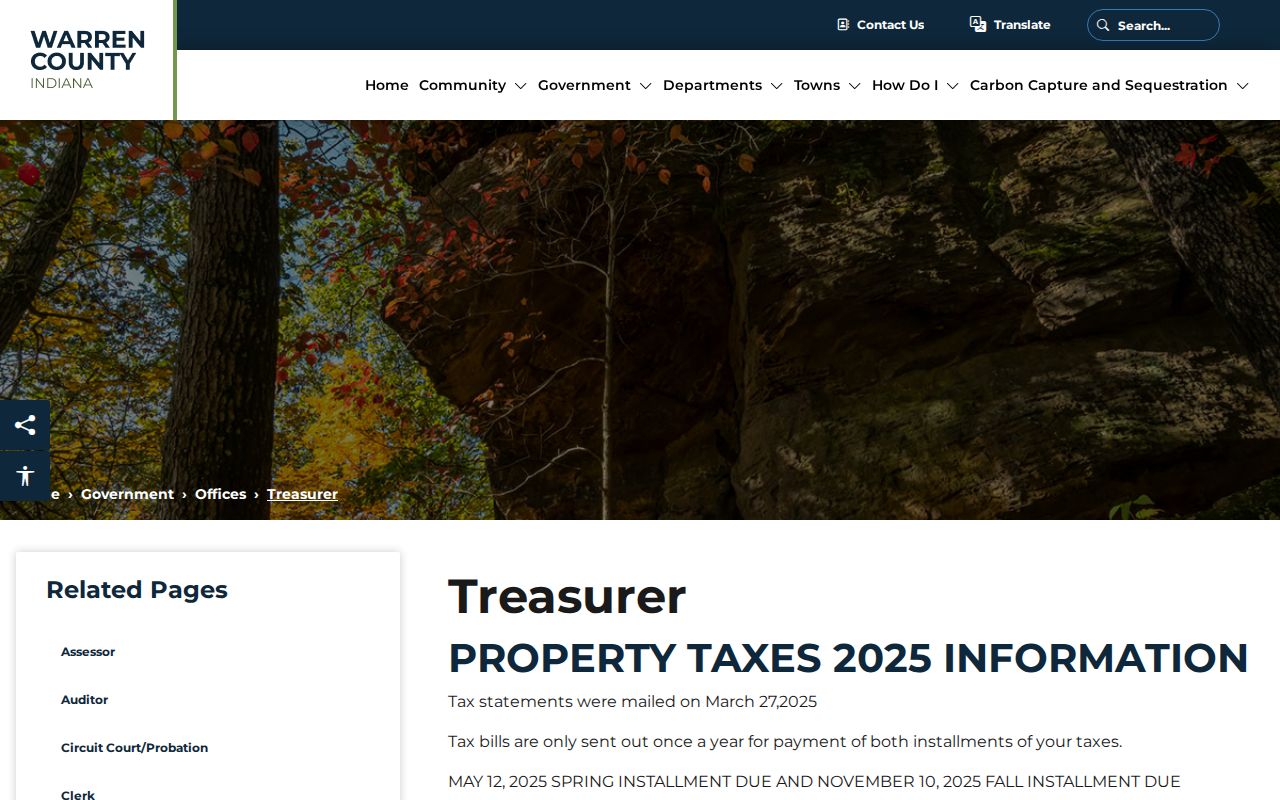
The official Treasurer page identifies the right payment route. Confirm installment dates each year, because the dates published for 2025 are not a perpetual calendar.
Verify Warren County Delinquency Separately
A missed installment alone tells you nothing about a sale. The Treasurer runs tax and certificate sales in Warren County. The Auditor keeps parcel and transfer data. A later instrument, once recorded, lands with the Recorder. Court or sheriff records can matter too. Warren County publishes no current sale-list portal online. A parcel-specific inquiry to the Treasurer is the reliable route.
Ask about the tax year, current balance, penalty, and whether a sale or certificate exists. Request redemption details and any instrument or case reference. Then match the answer to the exact parcel and legal description. A name-only hit is too weak when a list includes trusts, entities, and spelling variants.
Challenge a Warren County Assessment
An appeal targets value or another assessment issue. It does not dispute the collection of a correctly computed bill. Indiana's property-tax appeal page supplies Form 130. It walks through the route from the local assessor to PTABOA, then to the Indiana Board of Tax Review and Tax Court. Objective errors, such as a wrong description, differ from a subjective fight over value. The official appeal interface appears below. Get the current form there rather than a saved copy from an earlier year.
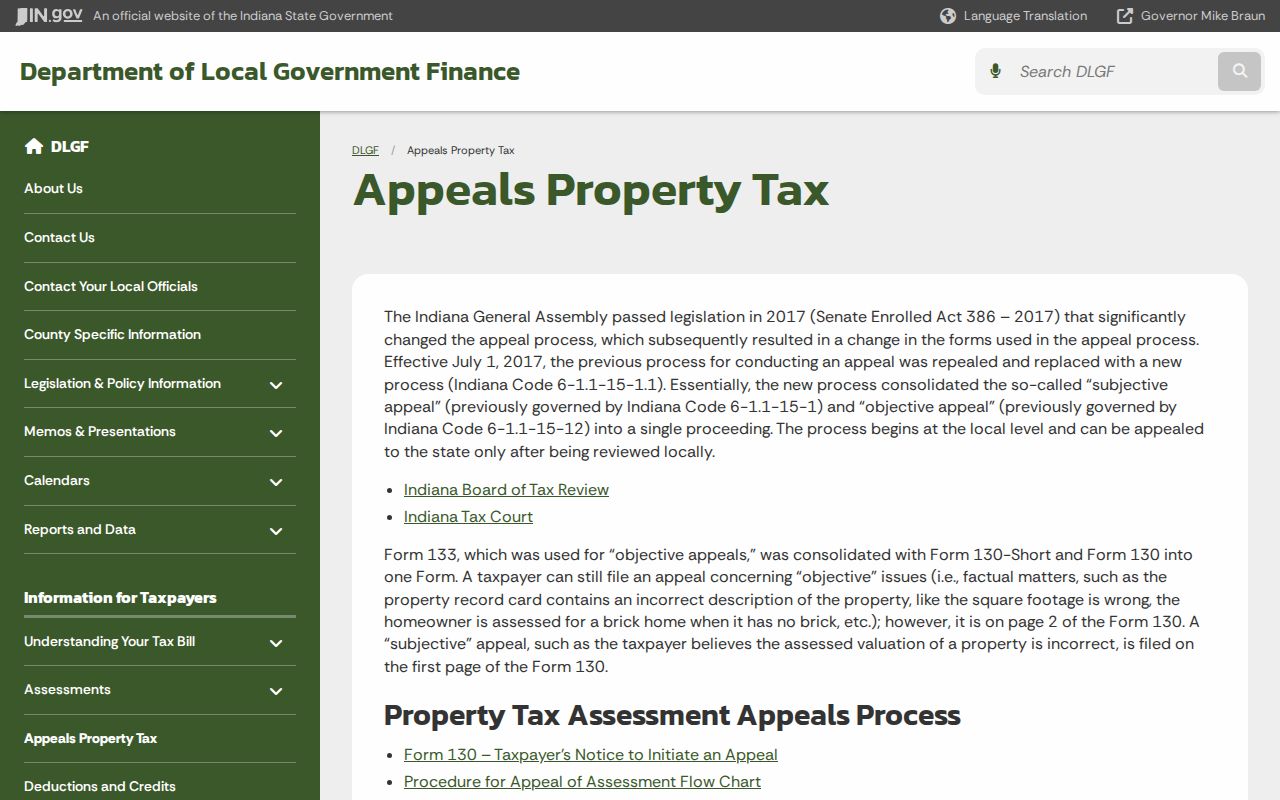
Work out the deadline from the current notice date and its instructions. Attach the parcel record, photos, sales evidence, corrected facts, or other support that fits the issue.
Appeal timing. Indiana generally uses June 15 or 45 days after notice, whichever is later; verify the date and file Form 130 with the local assessor on time.