
Trace Warren County Former Owners Transfer by Transfer
Rebuild the chain one conveyance at a time. Begin with the newest transfer you know. The Warren County Auditor parcel card can show dated deeded-owner rows and transfer types. Treat those rows as leads, not proof. A solid chain rests on the Recorder's grantor-grantee index and the deeds it cites, with the legal description holding steady when names or street addresses change.
| Transfer date | Grantor to grantee | Instrument clue | Next backward step |
|---|---|---|---|
| Latest dated row | Seller to present grantee | Recorded date, type, book/page or instrument | Search the seller as an earlier grantee |
| Earlier indexed deed | Prior seller to prior buyer | Matching legal description | Repeat under that seller's name |
| Probate or tax transfer | Estate, representative, or tax authority to grantee | Probate order or tax-deed reference | Pair the deed with the related file |
| Pre-digital deed | Historic grantor to grantee | Volume and page | Continue in reverse index and deed book |
The 500 South Clay Street card shows the point. Its transfer table lists Warranty Deed transfers in 2021, 2018, and 2014. The instrument, book, and page cells sit blank. The table is a map, not a substitute. Search those parties and dates through the Recorder-linked LandRecords service, then check the legal description against the image or the courthouse record.
Use the Warren Auditor History as a Starting Anchor
The Warren County Auditor Tax List accepts an owner name, property address, or parcel or property number. It also accepts a tax year. Open the matching real-estate page. Record the parcel number, map number, situs, legal description, and current deeded owner. Also record the dated former-owner rows and the transfer table. One sample card reaches back to 2005. That reflects one parcel's history, not countywide coverage.
Copy names exactly. One Warren result preserves "Harrison Steel Casting Co." A second row reads "Harrison Steel Castings Co." That single letter matters in a party-name index. Search corporate suffixes, initials, punctuation, trustee labels, and former names separately. A parcel may have been split or combined in the last two years. The tax-list instructions then recommend a last-name search to find all bills.
Note: Auditor transfer rows help frame dates. The recorded deed and matching land description provide the stronger ownership link.
Warren County Former Owners Before the Web Portal
Warren County publishes no earliest year for its online Recorder index. Do not turn that gap into a guessed cutoff. When the remote search stops, contact the Warren County Recorder at the courthouse, 125 North Monroe Street, Suite 10, Williamsport. Hours run Monday through Friday, 8:00 a.m. to 4:00 p.m. Eastern. The listed phone is (765) 764-5888.
Older chains have firmer footing. The Indiana State Library Warren County guide and its microfilm inventory list real coverage. Deed indexes span 1830-1900, and the general deed index begins in 1826. Deed-record volumes 1-53 run from 1827 to 1901. Tax-deed volumes cover 1862-1900 and 1865-1874. Remember, those dates describe microfilm holdings, not the online portal.
Coverage limit. Warren County's online Recorder cutoff is unpublished. Use the Recorder counter and State Library deed indexes or books when the remote index no longer reaches the needed year.
Reconstruct Warren County Prior Owners in Historic Books
Historic book work starts from a modern legal identity, not a house number. For a platted lot, the wording matters. Carry the addition, lot, and block language into every older search. Rural acreage needs township, range, section, quarter calls, bearings, distances, and referenced monuments. The Recorder index points to a volume and page. The deed itself supplies the full description and may cite an earlier instrument.
The State Library inventory supports a deliberate sequence. Check both grantor and grantee indexes, transcribing spelling variants and the book-page citation. Pull the cited deed. Compare the tract description and repeat. The Warren County Surveyor can provide original government surveys, section-corner monuments, benchmarks, legal surveys, USGS sheets, and historic maps. The office does not survey private land or settle a line dispute.
Go Back Through Warren County's Grantor-Grantee Chain
Read the chain in reverse. The present owner's acquisition deed names that owner as grantee and the seller as grantor. The grantor then becomes the next grantee to hunt. Dates and legal descriptions keep similarly named people or companies off the wrong parcel.
- Open the current parcel card and note its latest owner, transfer date, parcel ID, and legal description.
- Search that owner as grantee near the acquisition date and pull the matching deed.
- Read the grantor, instrument citation, and land description from that deed.
- Search the grantor as a grantee in an earlier date band, verify the same tract, and repeat.
- When remote coverage ends, move the book-page trail to the Recorder counter or State Library microfilm.
- Grantor and grantee
- The transferring party and the receiving party named by an instrument.
- Chain of title
- The linked sequence of instruments affecting the same land through time.
- Reverse index
- An index arranged to help locate a party in the opposite transaction role.
- Warranty and quitclaim deeds
- Different conveyance forms; neither label alone proves that an unbroken chain exists.
Let Probate Explain a Break in Warren Ownership
Estates explain many ownership gaps in Warren County. Land often left a family through a will rather than a sale. An administrator or executor might have sold the farm under a court order, and heirs may have signed off through distribution papers. Start in the Warren County Clerk's probate material: wills, appointment records, heirship evidence, and orders authorizing the sale of real estate. Then head back to the Recorder. That is where an administrator's deed, personal representative's deed, affidavit, or later conveyance formally moved the parcel out of the estate.
The State Library inventory covers probate and will runs reaching back to Warren County's early decades, with probate material running through 1928. Microfilm therefore pairs well with the deed books. Estate papers can show who had authority and how a family line succeeded, yet the recorded land instrument remains the true link between the estate and the parcel. Cemetery records, obituaries, and family histories offer useful leads. None of them replaces the deed.
Note: A deed chain may pass through an estate, tax deed, court order, or entity name change without following a simple sale pattern.
The 1907 Fire Did Not Erase Warren Deed History
A courthouse fire struck Warren County in 1907. An Indiana State Library guide confirms the blaze destroyed the commissioners' records. That loss is narrower than many assume. Deed volumes from 1827 through 1901 survive, along with deed indexes reaching 1900, according to the library's microfilm finding aid. So a substantial pre-fire land trail still exists for anyone tracing former owners in Warren County.
Gaps deserve precision. Commissioners' minutes, Recorder deed books, Clerk probate books, tax deeds, and Surveyor maps sit in separate collections. Before blaming destruction, ask the office or library about the exact volume and year. That habit may be the most useful skill in Warren County former-owner research.
Compare Former Warren Owners with the 1876 Atlas
The 1876 Warren County atlas map prints landowner names across its sections, along with railroads, rural buildings, and plans of Williamsport and West Lebanon. It can anchor a surname or a tract in period geography before any modern parcel number or street grid existed. Every printed landowner label is a lead. Test each one against the deed index and the volume behind it.
Plats also bridge old acreage and later town lots. A current Warren record card may describe land by addition and lot instead of acreage. Pull the recorded subdivision plat plus any amendments, vacations, replats, or lot-line changes that followed. That keeps the property search tied to the land itself, even when a former owner's address no longer matches the current situs address on the tax roll.
Measure the Time Depth of Warren County Ownership Records
Warren County was formed in 1827 out of Fountain County. Its deed-book run begins in that founding era. The State Library holds a general deed index starting in 1826. It also holds deed records from 1827 through 1901 on microfilm, plus deed indexes spanning 1830 to 1900. Later deed records stay with the Recorder. The remote portal publishes no start date for its coverage. Some tracts predate the county itself. In that case, follow the legal description into the predecessor jurisdiction and federal land sources. Do so only if the deed trail points that way.
Keep three dates straight. Consider the instrument date and the recording date. Add any portal update or tax year. Each means something different. The Auditor tax list displays a last-updated date. A sample card reads "2025 Payable 2026." Neither date tells you anything about the Recorder index's coverage. Write down the source and meaning beside every date. Then a future researcher can rebuild the former-owner chain.
Lawful use. Research previous owners for house history, estate work, boundary questions, or purchase diligence. Do not use public records to stalk, harass, threaten, or harm a living person.
Document Every Warren County Former-Owner Link
A surname list alone will not reproduce a chain. For each transfer, capture the grantor, the grantee, the instrument date, the recording date, the deed type, and the book and page or document number. Include any consideration shown and the full legal description. Record where each fact came from. Note when you retrieved it. A marginal reference pointing to a release, correction, assignment, or later instrument deserves a follow-up. Complete that step before you call the link complete.
Addresses make weak historical keys. Roads shift, house numbers change, and parcels split or merge under new postal labels. Warren's current records separate the property address, the owner mailing address, the APN, the map number, and the legal description. Carry the addition and lot for platted land, or the section and tract calls for rural tracts. When a split or combination changes the parcel number, keep both identifiers. Request the plat or transfer record that ties them together.
Plenty of former owners exited through something other than a warranty deed. Quitclaims, tax deeds, administrator deeds, court-ordered sales, affidavits, and entity reorganizations all reshape the chain. The State Library microfilm inventory names tax-deed volumes, probate books, wills, and deed indexes. A researcher can chase whichever event the Recorder index suggests. The Warren County Clerk stays the local custodian for probate and court files. MyCase offers public case information from Warren Circuit Court's documented Odyssey period beginning August 26, 2008. The Clerk holds the official record. Older files may still sit at the courthouse.
Close each step with a confidence statement tied to evidence. A tax-card owner-history row is only a lead. An index result identifies a candidate instrument. A matching deed image connects named parties to the described land. A certified copy authenticates the office record. None of these stands alone as a title opinion, but together they build a well-supported former-owner timeline.
Obtain Warren Former-Owner Proof at a Fair Cost
For older deeds, Tapestry and LandRecords work well. Their coverage must reach the years you need. Keep the courthouse as a fallback. Vendor charges for searching and images can differ from what the counter charges. The Recorder's own copy price is $1 per page. The office warns against outside solicitations asking around $109.50 or more for a single deed. Once you have the chain of title mapped, pull the exact deed you need. Ask for it by party name, date, legal description, and a book-page or instrument citation.
The Recorder also links a free Property Fraud Alert. It watches future filings under a name you choose. It cannot rebuild past ownership or certify an old chain. For historical proof, the index, the deed image, and the legal description still carry the weight. The older volume or microfilm route carries weight too.
Recognize the Warren Remote Deed Entry Point
Remote deed research runs through Fidlar's Tapestry EON login.
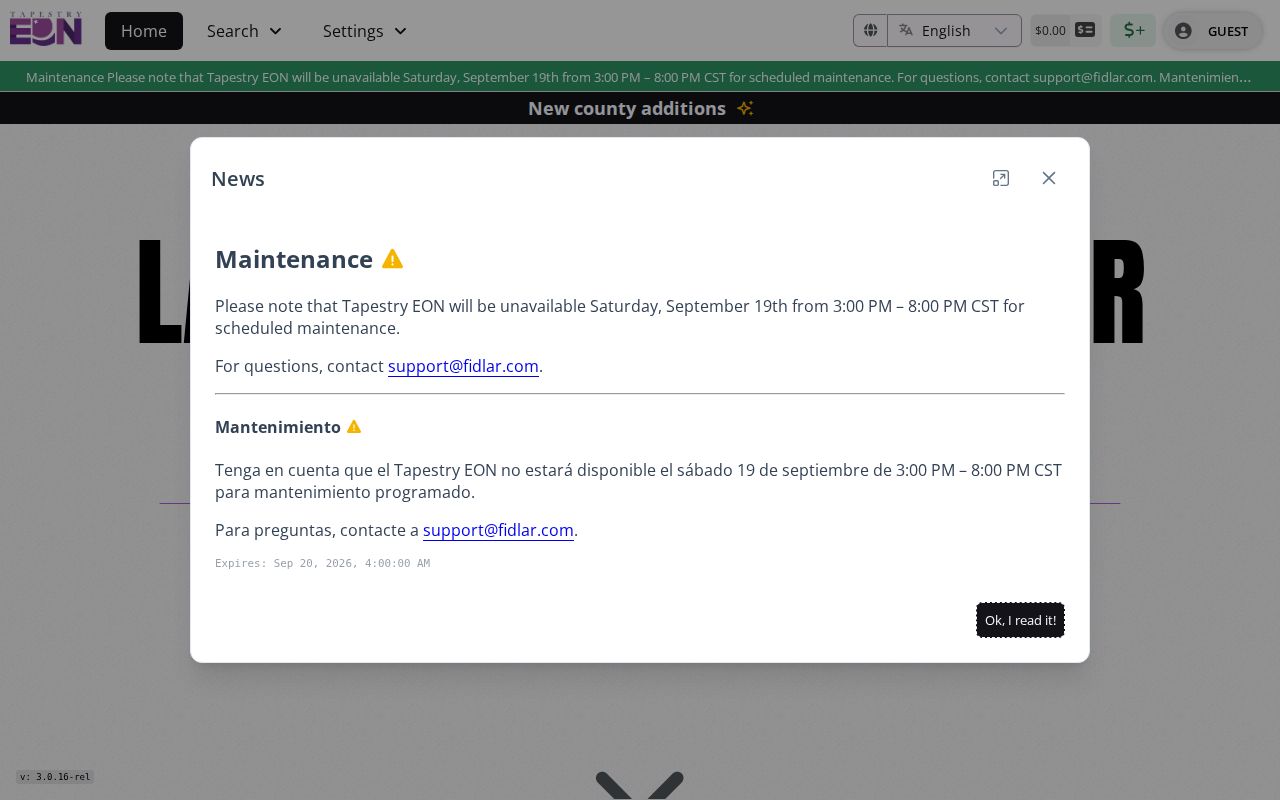
Treat this screen as a starting gate, not an answer. Pick Warren County, enter the grantor or grantee plus a date range, and then confirm that any instrument returned matches the parcel's legal description.